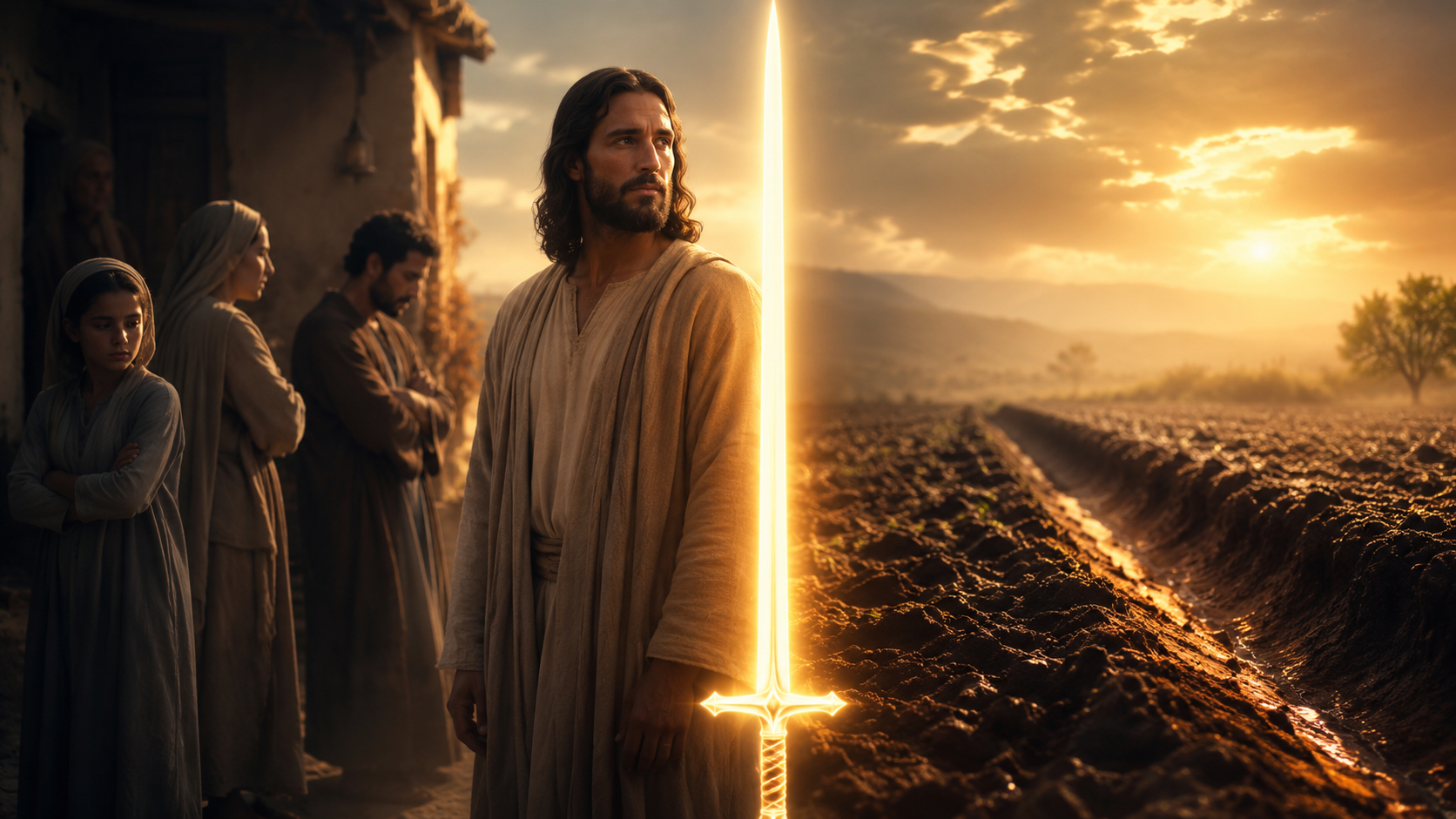
Divided by Love: What Jesus Really Meant When He Said He Came with a Sword

Mr. Dan Burk • Principal
June 29, 2026

7 Minute Read

Divided by Love: What Jesus Really Meant When He Said He Came with a Sword

Jesus said some of the most comforting words ever spoken. He also said some of the most challenging. In Matthew 10, He told His disciples plainly that He did not come to bring peace, but a sword. For anyone who knows Jesus as the Prince of Peace, that statement stops you cold. But when you understand what He meant, it changes how you think about faith, family, and where your deepest loyalty belongs.

What Was Jesus Actually Preparing His Disciples For?

Jesus was in the middle of preparing His twelve disciples to go out into the world as apostles. The word apostle comes from the Greek meaning "sent forth." These men had been learning from Jesus for nearly three years, and now He was getting ready to send them out to witness on His behalf.

His instructions were not soft. He was honest with them about what was coming. People would reject them. Families would be divided. And the very relationships they treasured most could become sources of conflict because of their faith in Him.

Why Did Jesus Say He Came with a Sword, Not Peace?

This is the part that catches people off guard. Jesus said in Matthew 10:

"Do not think that I have come to bring peace to the earth. I have not come to bring peace, but a sword." - Matthew 10:34 English Standard Version (ESV)

He then went further, echoing the words of the Old Testament prophet Micah:

"For I have come to set a man against his Father, and a daughter against her mother, and a daughter-in-law against her mother-in-law. And a person's enemies will be those of his own household." - Matthew 10:35-36 English Standard Version (ESV)

These are hard words. But understanding the literary technique Matthew used here helps. It is called dialectical negation. Jesus was using strong, emphatic language to make a point. A better way to hear what He was saying might be this: "I have come not only to bring peace, but even more, a sword." Because wherever the gospel goes, people will be divided by their response to it.

Did Jesus Really Come to Divide Families?

Yes and no. Jesus absolutely came to bring peace. The angels announced it at His birth in Luke 2:14. He told His disciples earlier in Matthew 10:13 to let their peace rest on every home that welcomed them. He is the Prince of Peace.

But He also knew that following Him would not be universally welcomed, even within families. The prophet Micah had already warned Israel that sin would cause division within households. Jesus was now saying something similar: faith in Him alone would cause the same kind of division. Not because He wanted conflict, but because the gospel demands a response, and not everyone responds the same way.

What Does "Rightly Ordered Love" Mean for Christians?

Throughout this portion of His missionary discourse, Jesus was calling His disciples to have what might be called rightly ordered love. Just as He called them to have rightly ordered fear (fearing God above what man can do to them), He was now calling them to love God above everything else, including family.

That is a difficult thing to hear. We love our parents. We love our children. We love our spouses. These are good and God-given relationships. But Jesus was clear that none of those relationships should come before our love and trust in Him.

He was not asking His disciples to abandon their families. He was asking them to make sure their deepest loyalty, their ultimate trust, belonged to God alone.

How Does This Apply to Witnessing and Sharing Your Faith?

One of the reasons this message matters so much today is that many Christians are afraid to share their faith. Research from Barna shows that 64% of Christians believe they have a responsibility to share their faith, down from 89% just 25 years ago. Even more striking, 70% of unchurched Americans say that a Christian friend has never once shared their faith with them.

Fear holds us back. Fear of rejection. Fear of saying the wrong thing. Fear of damaging a relationship.

But Jesus addressed that fear directly. He reminded His disciples that God knows when a sparrow falls to the ground. He knows the number of hairs on your head. If God cares about those small things, He will certainly care for you when you step out in faith to share the gospel.

"Are not two sparrows sold for a penny? And not one of them will fall to the ground apart from your Father. But even the hairs of your head are all numbered. Fear not, therefore; you are of more value than many sparrows." - Matthew 10:29-31 English Standard Version (ESV)

What Is the Reward for Those Who Follow Christ Above All Else?

Jesus did not leave His disciples without hope in this hard message. He promised that those who receive His missionaries, even in something as small as giving one of them a cup of water, would receive the same reward as the missionary. Faith expressed in even small acts of care for those sharing the gospel carries eternal weight.

Baptism into the name of the triune God is where the Holy Spirit plants the mind of Christ within us. From that foundation, we are called to live out our faith in the world, even when it costs us something.

The Image of the Plow: Opening the Heart for the Gospel

There is a powerful image behind Jesus' words here. When He comes with a sword, He is not coming to destroy. He is coming like a plow that cuts open the ground so that seed can be planted. He opens a furrow in the heart so that the seed of His redemption can take root.

His words to His disciples were not meant to discourage them. They were meant to prepare them. He was honest about the difficulty ahead so that when conflict came, they would not be surprised. They would know that the division was not a sign that something had gone wrong. It was a sign that the gospel was doing exactly what it was meant to do.

Two Camps: Where Does Your Love Belong?

Jesus made clear that His coming would create two groups of people. Those who put their love and trust in Him above all earthly relationships and possessions. And those who love the world, their comfort, their family approval, or their earthly security more than they love God.

This is not a call to be harsh or cold toward family. It is a call to make sure that when push comes to shove, when faith costs something, our love for Christ holds firm.

Life Application

This week, consider where your deepest loyalty actually lives. It is easy to say we love God above all things. It is harder to live that way when faith creates friction in a relationship or costs us something we value.

The challenge this week is simple but not easy: identify one relationship or situation where fear has kept you from living out or sharing your faith, and take one small step toward courage. It does not have to be a grand gesture. It might be a conversation, a text, an invitation, or simply being honest about what you believe when the moment comes.

Ask yourself:

  • Is my love for God truly ordered above my love for the approval of others, including family?
  • Is there someone in my life who has never heard me share what Christ means to me?
  • What specific fear is keeping me from witnessing, and have I brought that fear honestly before God?
  • When conflict arises because of my faith, do I see it as a failure or as the gospel doing its work?

Jesus did not promise His followers an easy road. He promised to be with them on it. That is enough to take the next step.

Up Next
From this Tag: Christian Discipleship
July 13, 2026 • 7 Minute Read
The Faithful Sower: What the Parables of the Soils Teaches Us about God's Word and Our Hearts
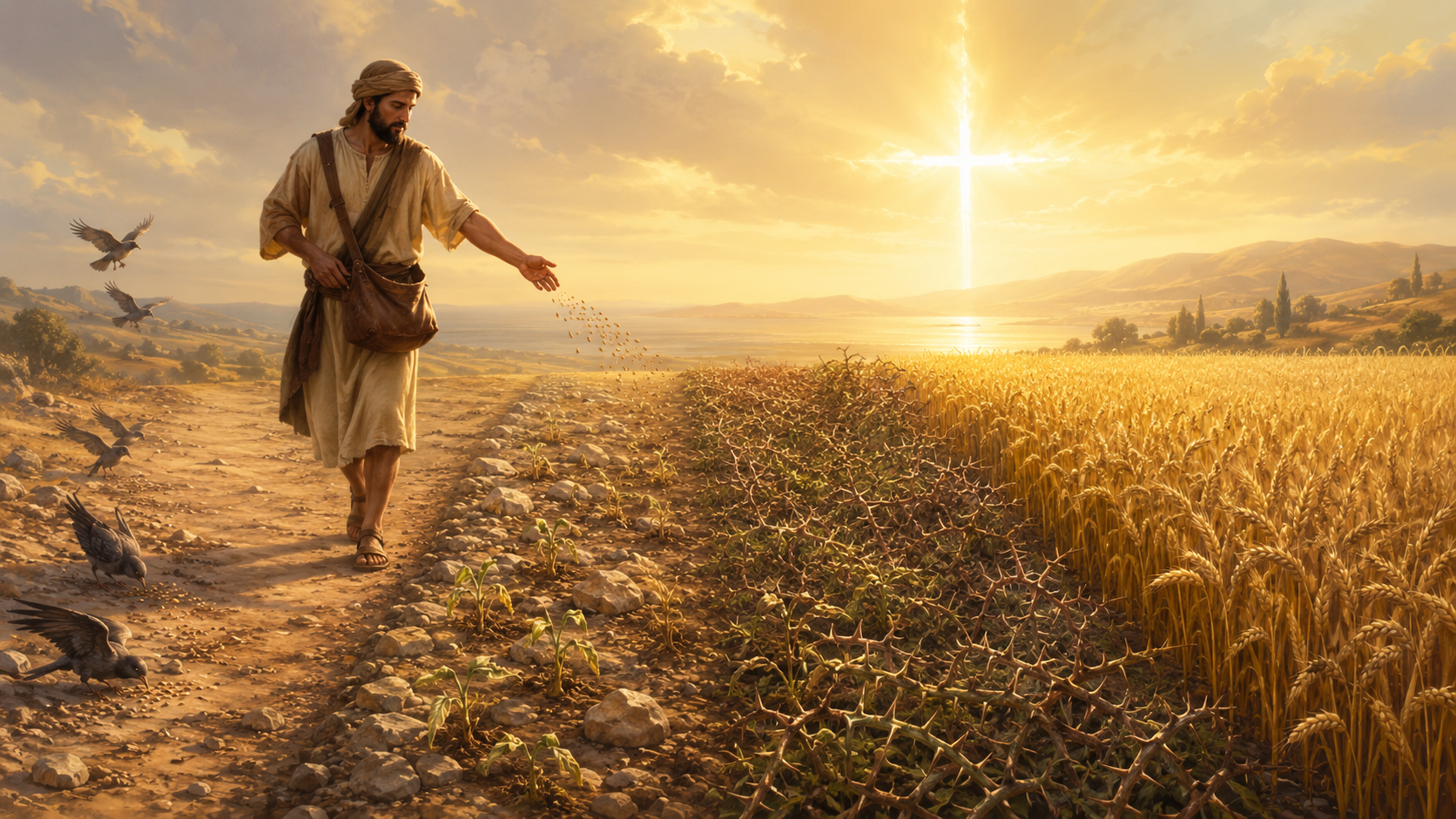
The Faithful Sower: What the Parable of the Soils Teaches Us About God's Word and Our Hearts God's Word is powerful enough to raise the dead, and yet people resist it every day. Jesus holds both of these truths together in one of His most well-known parables, and understanding them changes everything about how we see faith, struggle, and the grace of God. Does God's Word Always Work? The prophet Isaiah leaves no room for doubt. He describes rain falling on the earth, soaking into the ground, producing green growth, and eventually bread on the table. Then he says, "So shall my word be that goes out from my mouth; it shall not return to me empty, but it shall accomplish that which I purpose, and shall succeed in the thing for which I sent it." - Isaiah 55:11 English Standard Version (ESV) When God speaks, things happen. Light shines. The sea parts. The dead are raised. Sinners are forgiven. God's Word is living and powerful. And yet, Jesus tells a story where much of the seed seems to be lost. So which is it? Is God's Word unstoppable, or can people resist it? Jesus says both are true. What Is the Parable of the Sower Really About? A farmer walks through a field with a leather pouch of seed, reaching in and flinging it into the air. The seed lands in four different places. Some falls on a hard path and birds snatch it away. Some falls on rocky ground, sprouts quickly, but dies in the sun because there is no root. Some falls among thorns, which slowly choke the life out of the plant. And some falls on good soil and yields a harvest thirty, sixty, even a hundred times what was sown. Jesus explains the parable clearly. The seed is the Word of God. The field is the human heart. This story about farming is not really about farming at all. It is about us. What Do the Four Soils Represent in Our Lives? The Hard Path: When Distraction Steals the Word The seed that falls on the hard path is snatched away by birds. Jesus says the evil one comes and takes away what was sown. The devil does not need to convince anyone that the Bible is false. He only needs to keep us distracted. God's Word speaks on a Sunday. It convicts. It comforts. Then Monday comes, the phone rings, the news goes on, and by Tuesday the sermon is forgotten. Hardness of heart often looks less like rebellion and more like busyness. The Rocky Ground: When Faith Has No Roots The seed on rocky ground sprouts quickly and looks healthy at first. But when the sun comes out, the plant dies because the roots never went deep. Faith cannot live on emotion alone. It needs roots that go deep into God's promises. There are moments when following Jesus is exciting and energizing. But there are also moments when it costs something. Jesus never promised the Christian life would be easy. He promised He would always be with us. The Thorny Ground: When Good Things Crowd Out God The thorns are not obviously evil. They are the worries of this life, the deceitfulness of riches, and the pleasures of life. Bills, careers, sports, vacations, busy schedules. None of those things look like enemies on their own. But together, they slowly crowd Jesus out. Faith rarely disappears overnight. More often it gets crowded out. Prayer becomes less frequent. Worship becomes occasional. Scripture sits unopened. The thorns work quietly, almost unnoticed, but they choke the life out of faith. Which Soil Are You? It is tempting to look at these soils and think of someone else. But Jesus holds up a mirror. Where has your heart become hard? Where has your faith grown shallow? Where have the thorns begun to grow? If we are honest, we can find every one of those soils somewhere in our own hearts. Sometimes we have ignored God's Word. Sometimes we have doubted His promises. Sometimes we have loved other things more than we love Jesus. And here is the frightening part: we cannot fix our own hearts. A path cannot soften itself. A rock cannot make itself go deeper. Thorns never pull themselves out. Left to ourselves, our hearts remain exactly as they are. Who Is the Main Character in This Parable? If we are not careful, we treat this parable as mostly being about dirt. Four kinds of soil, four kinds of hearts. But the main character is not the soil. The main character is the sower. Watch him. He sees the hard path. He sees the rocks. He sees the thorns. And he keeps sowing. He does not skip the difficult ground. He does not save his seed only for the best soil. He keeps scattering his Word again and again. Every Sunday, every baptism, every absolution, every Lord's Supper, every Scripture reading, every conversation about Jesus. The sower never stops sowing. How the Cross Changes Everything in This Parable The greatest resistance to God's Word did not come from birds or rocks or thorns. It came from the world itself. Religious leaders rejected Jesus. The crowds cried out for His crucifixion. His own disciples ran away. It looked as though the sower had failed. But Jesus once said, "Truly, truly, I say to you, unless a grain of wheat falls into the earth and dies, it remains alone; but if it dies, it bears much fruit." - John 12:24 English Standard Version (ESV) The sower became the seed. He entered the ground. He died. And on the third day, He rose again. Now He bears a harvest no one can count. Remember the thorns that choked the plants? Later in Matthew's Gospel, that image appears again. Soldiers form a crown of thorns and place it on Jesus' head. In Genesis 3, thorns are a consequence of sin. He bore our sin. He bore our thorns, our hardness, our shallow faith, our divided hearts. He carried them all to the cross so that forgiveness, life, and salvation could grow in us. What Is the Real Miracle in This Parable? The miracle is not that some people finally become better soil. The miracle is that the Holy Spirit keeps working through the gospel. Hard hearts are broken open. Dead hearts come alive. Faith is created. Hope is born. Forgiveness is spoken. The gospel does what we cannot do for ourselves. It creates what it commands. That is why Isaiah can say God's Word will not return empty. His purposes are accomplished not because no one resists, but because God accomplishes what He desires through His Word. So do not spend your whole life looking at the soil. Look at the sower. He is still walking. He is still scattering seed. He is still speaking, forgiving, calling, and saving. Wherever His Word takes root, there is life, sixtyfold, a hundredfold. Life Application Maybe today your heart feels hard. Maybe your faith has grown shallow. Maybe the worries of life have wrapped themselves around your heart like thorns and are slowly choking out what once felt alive. Hear this good news: Jesus has not stopped sowing. He has come for you. His Word is still living, still powerful, still forgiving, still creating faith, and still bearing fruit. This week, identify one thorn in your life. One distraction, one worry, one pleasure that has been quietly crowding out time with God. Then take one concrete step to remove it. Open your Bible on a day you normally would not. Return to prayer even if it feels dry. Come to worship even when life feels busy. You cannot change your own soil, but you can place yourself where the sower is still sowing. Ask yourself these questions as you go through your week: Where in my life have I allowed distraction to steal God's Word before it takes root? Is my faith built on deep roots in God's promises, or is it dependent on feelings and circumstances? What thorns have been quietly growing in my heart, and am I willing to bring them to Jesus? Am I looking at the soil of my own heart, or am I looking to the faithful sower who never stops coming for me?
Currently Reading
June 29, 2026 • 7 Minute Read
Divided by Love: What Jesus Really Meant When He Said He Came with a Sword
Divided by Love: What Jesus Really Meant When He Said He Came with a Sword Jesus said some of the most comforting words ever spoken. He also said some of the most challenging. In Matthew 10, He told His disciples plainly that He did not come to bring peace, but a sword. For anyone who knows Jesus as the Prince of Peace, that statement stops you cold. But when you understand what He meant, it changes how you think about faith, family, and where your deepest loyalty belongs. What Was Jesus Actually Preparing His Disciples For? Jesus was in the middle of preparing His twelve disciples to go out into the world as apostles. The word apostle comes from the Greek meaning "sent forth." These men had been learning from Jesus for nearly three years, and now He was getting ready to send them out to witness on His behalf. His instructions were not soft. He was honest with them about what was coming. People would reject them. Families would be divided. And the very relationships they treasured most could become sources of conflict because of their faith in Him. Why Did Jesus Say He Came with a Sword, Not Peace? This is the part that catches people off guard. Jesus said in Matthew 10: "Do not think that I have come to bring peace to the earth. I have not come to bring peace, but a sword." - Matthew 10:34 English Standard Version (ESV) He then went further, echoing the words of the Old Testament prophet Micah: "For I have come to set a man against his Father, and a daughter against her mother, and a daughter-in-law against her mother-in-law. And a person's enemies will be those of his own household." - Matthew 10:35-36 English Standard Version (ESV) These are hard words. But understanding the literary technique Matthew used here helps. It is called dialectical negation. Jesus was using strong, emphatic language to make a point. A better way to hear what He was saying might be this: "I have come not only to bring peace, but even more, a sword." Because wherever the gospel goes, people will be divided by their response to it. Did Jesus Really Come to Divide Families? Yes and no. Jesus absolutely came to bring peace. The angels announced it at His birth in Luke 2:14. He told His disciples earlier in Matthew 10:13 to let their peace rest on every home that welcomed them. He is the Prince of Peace. But He also knew that following Him would not be universally welcomed, even within families. The prophet Micah had already warned Israel that sin would cause division within households. Jesus was now saying something similar: faith in Him alone would cause the same kind of division. Not because He wanted conflict, but because the gospel demands a response, and not everyone responds the same way. What Does "Rightly Ordered Love" Mean for Christians? Throughout this portion of His missionary discourse, Jesus was calling His disciples to have what might be called rightly ordered love. Just as He called them to have rightly ordered fear (fearing God above what man can do to them), He was now calling them to love God above everything else, including family. That is a difficult thing to hear. We love our parents. We love our children. We love our spouses. These are good and God-given relationships. But Jesus was clear that none of those relationships should come before our love and trust in Him. He was not asking His disciples to abandon their families. He was asking them to make sure their deepest loyalty, their ultimate trust, belonged to God alone. How Does This Apply to Witnessing and Sharing Your Faith? One of the reasons this message matters so much today is that many Christians are afraid to share their faith. Research from Barna shows that 64% of Christians believe they have a responsibility to share their faith, down from 89% just 25 years ago. Even more striking, 70% of unchurched Americans say that a Christian friend has never once shared their faith with them. Fear holds us back. Fear of rejection. Fear of saying the wrong thing. Fear of damaging a relationship. But Jesus addressed that fear directly. He reminded His disciples that God knows when a sparrow falls to the ground. He knows the number of hairs on your head. If God cares about those small things, He will certainly care for you when you step out in faith to share the gospel. "Are not two sparrows sold for a penny? And not one of them will fall to the ground apart from your Father. But even the hairs of your head are all numbered. Fear not, therefore; you are of more value than many sparrows." - Matthew 10:29-31 English Standard Version (ESV) What Is the Reward for Those Who Follow Christ Above All Else? Jesus did not leave His disciples without hope in this hard message. He promised that those who receive His missionaries, even in something as small as giving one of them a cup of water, would receive the same reward as the missionary. Faith expressed in even small acts of care for those sharing the gospel carries eternal weight. Baptism into the name of the triune God is where the Holy Spirit plants the mind of Christ within us. From that foundation, we are called to live out our faith in the world, even when it costs us something. The Image of the Plow: Opening the Heart for the Gospel There is a powerful image behind Jesus' words here. When He comes with a sword, He is not coming to destroy. He is coming like a plow that cuts open the ground so that seed can be planted. He opens a furrow in the heart so that the seed of His redemption can take root. His words to His disciples were not meant to discourage them. They were meant to prepare them. He was honest about the difficulty ahead so that when conflict came, they would not be surprised. They would know that the division was not a sign that something had gone wrong. It was a sign that the gospel was doing exactly what it was meant to do. Two Camps: Where Does Your Love Belong? Jesus made clear that His coming would create two groups of people. Those who put their love and trust in Him above all earthly relationships and possessions. And those who love the world, their comfort, their family approval, or their earthly security more than they love God. This is not a call to be harsh or cold toward family. It is a call to make sure that when push comes to shove, when faith costs something, our love for Christ holds firm. Life Application This week, consider where your deepest loyalty actually lives. It is easy to say we love God above all things. It is harder to live that way when faith creates friction in a relationship or costs us something we value. The challenge this week is simple but not easy: identify one relationship or situation where fear has kept you from living out or sharing your faith, and take one small step toward courage. It does not have to be a grand gesture. It might be a conversation, a text, an invitation, or simply being honest about what you believe when the moment comes. Ask yourself: Is my love for God truly ordered above my love for the approval of others, including family? Is there someone in my life who has never heard me share what Christ means to me? What specific fear is keeping me from witnessing, and have I brought that fear honestly before God? When conflict arises because of my faith, do I see it as a failure or as the gospel doing its work? Jesus did not promise His followers an easy road. He promised to be with them on it. That is enough to take the next step.
May 7, 2026 • 6 Minute Read
The Witness of Stephen: Following Christ Even in Opposition
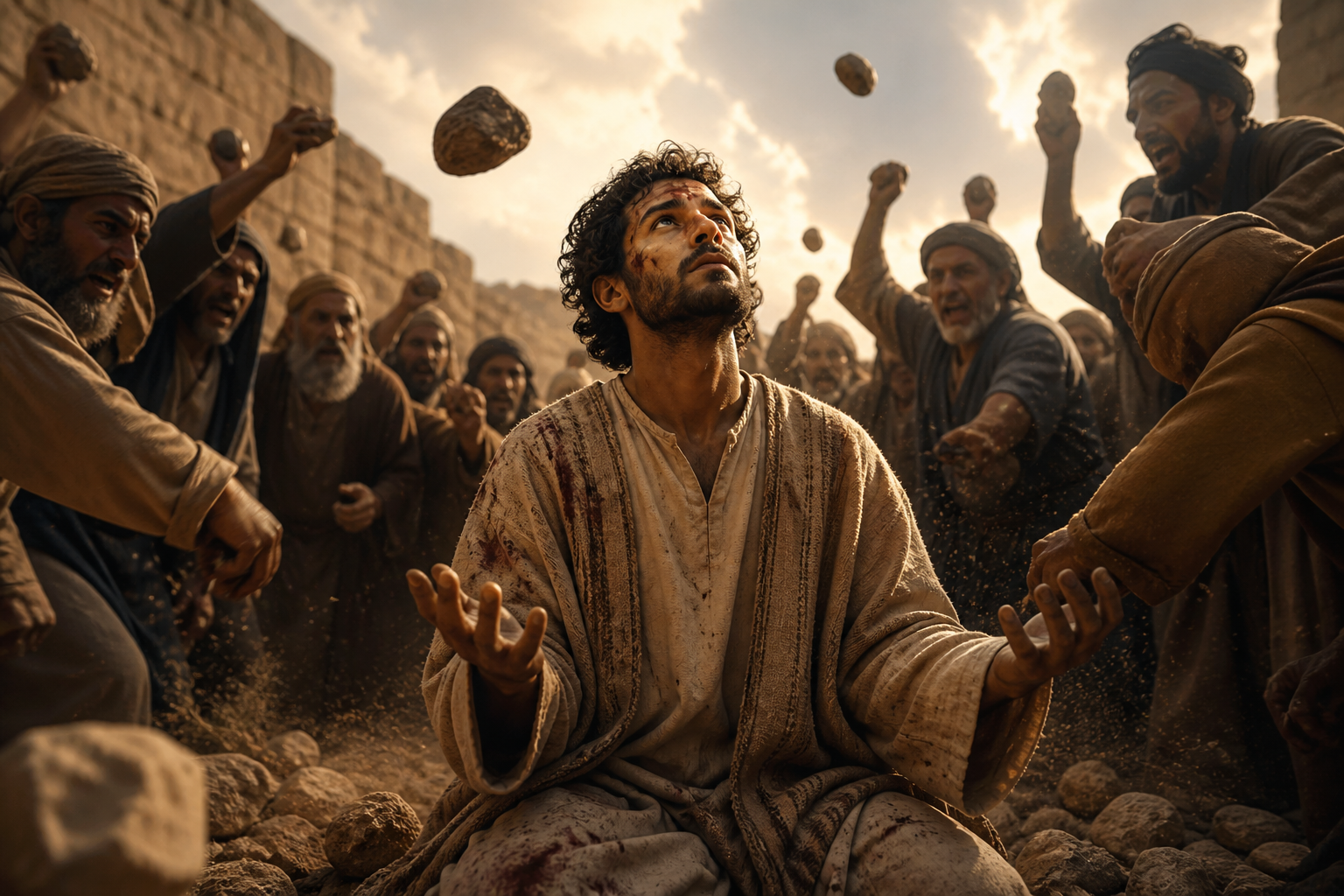
Stephen's story from Acts 6-7 offers a powerful example of faithful witness in the face of persecution. His martyrdom wasn't just an ending—it was the culmination of a life dedicated to serving others and boldly proclaiming the truth about Jesus Christ. How Did Stephen Begin His Ministry? Stephen didn't start as a preacher or theologian. He was chosen for a practical need: serving widows in the early church. The twelve apostles were overwhelmed with the growing congregation's needs, particularly food distribution to widows in their community. They appointed seven men, including Stephen, to handle this vital service. But God had bigger plans. Through Stephen's faithful service in this seemingly simple role, God worked "great signs and wonders among the people." This demonstrates how God uses our everyday vocations—whether serving meals, teaching children, or working in an office—to accomplish His purposes. What Made Stephen's Defense So Powerful? When Stephen was brought before the Sanhedrin (the Jewish Supreme Court), he faced the same false accusations that Jesus had encountered. They accused him of blasphemy and speaking against Moses and the prophets. But Stephen, filled with the Holy Spirit, delivered a masterful defense that his opponents couldn't refute. Stephen's Historical Journey Through Scripture Stephen's sermon took his accusers on a journey through Jewish history, showing a consistent pattern: Abraham's Call: He reminded them that their father Abraham was originally a pagan from Ur of the Chaldeans (modern-day Iraq). God called him out of paganism to follow Him, making Abraham a sojourner who trusted God's promises without seeing their fulfillment. Joseph's Story: Stephen recounted how Joseph's brothers, driven by jealousy, sold him into slavery. Yet God was with Joseph, elevating him to second-in-command in Egypt. When famine struck, Joseph's brothers came seeking help, and Joseph forgave them—foreshadowing the forgiveness Christ offers. Moses the Deliverer: Stephen described how God raised up Moses to deliver His people from Egyptian bondage. Yet even after witnessing miraculous signs and wonders, the Israelites rejected Moses and created a golden calf while he received the law on Mount Sinai. The Pattern of Rejection Through this historical narrative, Stephen revealed a troubling pattern: God repeatedly delivered His people, yet they consistently rejected Him and His messengers. The prophets who called them to repentance were persecuted. The kings who tried to lead them back to God were opposed. Why Did Stephen's Message Provoke Such Anger? Stephen concluded his defense with a direct challenge: "You stiff-necked people, uncircumcised in heart and ears, you always resist the Holy Spirit, as your fathers did, so do you. Which of the prophets did your fathers not persecute? And they killed those who announced beforehand the coming of the Righteous One, whom you have now betrayed and murdered." This wasn't just a history lesson—it was an indictment. Stephen was telling them they were following the same pattern of rejection that had characterized their ancestors. They had rejected the ultimate Prophet, the Messiah Himself. How Did Stephen Face Death? The crowd's response was immediate and violent. They ground their teeth in rage and began stoning Stephen. But in his final moments, something remarkable happened. Stephen looked up and saw a vision of Christ standing at the right hand of God. This vision of the risen, glorified Christ gave him strength to face death with grace. Most significantly, as the stones struck him, Stephen prayed, "Lord, do not hold this sin against them." This prayer echoes Jesus' words from the cross: "Father, forgive them, for they know not what they do" (Luke 23:34 ESV). Even in his agony, Stephen demonstrated the transforming power of Christ's love. What Can We Learn About Witnessing for Christ? Stephen's example teaches us several crucial lessons about Christian witness: Faithfulness in Small Things: Stephen started by serving widows. God used his faithfulness in this practical ministry to prepare him for greater service. The Power of the Holy Spirit: When confronted by learned opponents, Stephen didn't rely on his own wisdom. The Holy Spirit gave him words that confounded his accusers. Courage in Opposition: Stephen didn't soften his message when facing a hostile audience. He spoke truth even when it cost him his life. Forgiveness for Enemies: Perhaps most challenging of all, Stephen prayed for those who were killing him. This supernatural response could only come from someone filled with Christ's love. Who Was Watching Stephen's Martyrdom? Among the crowd that day was a young man named Saul, holding the garments of those who stoned Stephen. This same Saul would later encounter the risen Christ on the road to Damascus and become the apostle Paul. Stephen's faithful witness, even unto death, planted seeds that would bear fruit in one of Christianity's greatest missionaries. What Does This Mean for Modern Christians? Stephen's story isn't just ancient history—it's a call to faithful witness in our own time. We may not face literal stoning, but we will encounter opposition when we stand for Christ's truth. The question is: will we respond with Stephen's courage and grace? Christ calls us to be witnesses in every role we fill—as parents, employees, neighbors, and church members. We don't need to deliver eloquent sermons like Stephen, but we can share the simple truth: "Christ died for me and everything I had done wrong, and He will do the same for you." Life Application This week, ask yourself: Am I faithfully serving Christ in the "small" roles He's given me? Stephen's ministry began with serving widows, but God used that faithfulness to prepare him for greater witness. Whether you're changing diapers, working at a desk, or teaching a class, God can use your faithful service as a platform for witness. Consider these questions as you reflect on Stephen's example: When faced with opposition to my faith, do I respond with grace or defensiveness? Am I prepared to share the simple truth of what Christ has done for me? Can I pray for those who oppose or mistreat me, as Stephen did for his executioners? How is God calling me to be a witness in my current circumstances, even if they seem ordinary? Stephen's witness reminds us that following Christ may be costly, but it's always worth it. The risen Christ who gave Stephen strength to face martyrdom is the same Christ who empowers us to live faithfully today.