The Faithful Sower: What the Parable of the Soils Teaches Us About God's Word and Our Hearts
God's Word is powerful enough to raise the dead, and yet people resist it every day. Jesus holds both of these truths together in one of His most well-known parables, and understanding them changes everything about how we see faith, struggle, and the grace of God.
Does God's Word Always Work?
The prophet Isaiah leaves no room for doubt. He describes rain falling on the earth, soaking into the ground, producing green growth, and eventually bread on the table. Then he says, "So shall my word be that goes out from my mouth; it shall not return to me empty, but it shall accomplish that which I purpose, and shall succeed in the thing for which I sent it." - Isaiah 55:11 English Standard Version (ESV)
When God speaks, things happen. Light shines. The sea parts. The dead are raised. Sinners are forgiven. God's Word is living and powerful.
And yet, Jesus tells a story where much of the seed seems to be lost. So which is it? Is God's Word unstoppable, or can people resist it?
Jesus says both are true.
What Is the Parable of the Sower Really About?
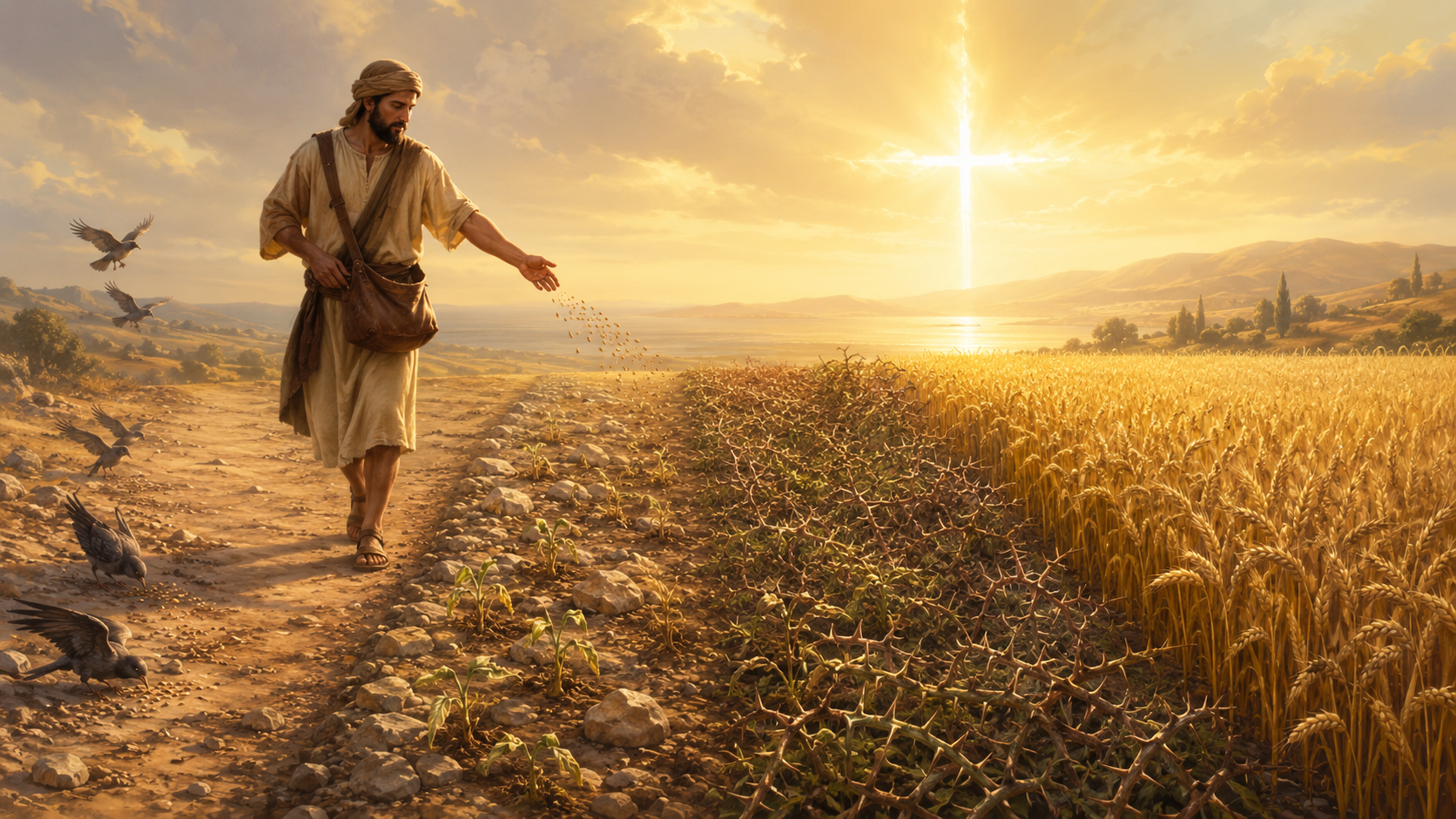
A farmer walks through a field with a leather pouch of seed, reaching in and flinging it into the air. The seed lands in four different places. Some falls on a hard path and birds snatch it away. Some falls on rocky ground, sprouts quickly, but dies in the sun because there is no root. Some falls among thorns, which slowly choke the life out of the plant. And some falls on good soil and yields a harvest thirty, sixty, even a hundred times what was sown.
Jesus explains the parable clearly. The seed is the Word of God. The field is the human heart. This story about farming is not really about farming at all. It is about us.
What Do the Four Soils Represent in Our Lives?
The Hard Path: When Distraction Steals the Word
The seed that falls on the hard path is snatched away by birds. Jesus says the evil one comes and takes away what was sown. The devil does not need to convince anyone that the Bible is false. He only needs to keep us distracted.
God's Word speaks on a Sunday. It convicts. It comforts. Then Monday comes, the phone rings, the news goes on, and by Tuesday the sermon is forgotten. Hardness of heart often looks less like rebellion and more like busyness.
The Rocky Ground: When Faith Has No Roots
The seed on rocky ground sprouts quickly and looks healthy at first. But when the sun comes out, the plant dies because the roots never went deep. Faith cannot live on emotion alone. It needs roots that go deep into God's promises.
There are moments when following Jesus is exciting and energizing. But there are also moments when it costs something. Jesus never promised the Christian life would be easy. He promised He would always be with us.
The Thorny Ground: When Good Things Crowd Out God
The thorns are not obviously evil. They are the worries of this life, the deceitfulness of riches, and the pleasures of life. Bills, careers, sports, vacations, busy schedules. None of those things look like enemies on their own.
But together, they slowly crowd Jesus out. Faith rarely disappears overnight. More often it gets crowded out. Prayer becomes less frequent. Worship becomes occasional. Scripture sits unopened. The thorns work quietly, almost unnoticed, but they choke the life out of faith.
Which Soil Are You?
It is tempting to look at these soils and think of someone else. But Jesus holds up a mirror. Where has your heart become hard? Where has your faith grown shallow? Where have the thorns begun to grow?
If we are honest, we can find every one of those soils somewhere in our own hearts. Sometimes we have ignored God's Word. Sometimes we have doubted His promises. Sometimes we have loved other things more than we love Jesus.
And here is the frightening part: we cannot fix our own hearts. A path cannot soften itself. A rock cannot make itself go deeper. Thorns never pull themselves out. Left to ourselves, our hearts remain exactly as they are.
Who Is the Main Character in This Parable?
If we are not careful, we treat this parable as mostly being about dirt. Four kinds of soil, four kinds of hearts. But the main character is not the soil. The main character is the sower.
Watch him. He sees the hard path. He sees the rocks. He sees the thorns. And he keeps sowing. He does not skip the difficult ground. He does not save his seed only for the best soil. He keeps scattering his Word again and again.
Every Sunday, every baptism, every absolution, every Lord's Supper, every Scripture reading, every conversation about Jesus. The sower never stops sowing.
How the Cross Changes Everything in This Parable
The greatest resistance to God's Word did not come from birds or rocks or thorns. It came from the world itself. Religious leaders rejected Jesus. The crowds cried out for His crucifixion. His own disciples ran away. It looked as though the sower had failed.
But Jesus once said, "Truly, truly, I say to you, unless a grain of wheat falls into the earth and dies, it remains alone; but if it dies, it bears much fruit." - John 12:24 English Standard Version (ESV)
The sower became the seed. He entered the ground. He died. And on the third day, He rose again. Now He bears a harvest no one can count.
Remember the thorns that choked the plants? Later in Matthew's Gospel, that image appears again. Soldiers form a crown of thorns and place it on Jesus' head. In Genesis 3, thorns are a consequence of sin. He bore our sin. He bore our thorns, our hardness, our shallow faith, our divided hearts. He carried them all to the cross so that forgiveness, life, and salvation could grow in us.
What Is the Real Miracle in This Parable?
The miracle is not that some people finally become better soil. The miracle is that the Holy Spirit keeps working through the gospel. Hard hearts are broken open. Dead hearts come alive. Faith is created. Hope is born. Forgiveness is spoken.
The gospel does what we cannot do for ourselves. It creates what it commands. That is why Isaiah can say God's Word will not return empty. His purposes are accomplished not because no one resists, but because God accomplishes what He desires through His Word.
So do not spend your whole life looking at the soil. Look at the sower. He is still walking. He is still scattering seed. He is still speaking, forgiving, calling, and saving. Wherever His Word takes root, there is life, sixtyfold, a hundredfold.
Life Application
Maybe today your heart feels hard. Maybe your faith has grown shallow. Maybe the worries of life have wrapped themselves around your heart like thorns and are slowly choking out what once felt alive. Hear this good news: Jesus has not stopped sowing. He has come for you. His Word is still living, still powerful, still forgiving, still creating faith, and still bearing fruit.
This week, identify one thorn in your life. One distraction, one worry, one pleasure that has been quietly crowding out time with God. Then take one concrete step to remove it. Open your Bible on a day you normally would not. Return to prayer even if it feels dry. Come to worship even when life feels busy. You cannot change your own soil, but you can place yourself where the sower is still sowing.
Ask yourself these questions as you go through your week:
- Where in my life have I allowed distraction to steal God's Word before it takes root?
- Is my faith built on deep roots in God's promises, or is it dependent on feelings and circumstances?
- What thorns have been quietly growing in my heart, and am I willing to bring them to Jesus?
- Am I looking at the soil of my own heart, or am I looking to the faithful sower who never stops coming for me?