
“I am the resurrection and the life. Whoever believes in me, though he die, yet shall he live.” John 11:25 (ESV)
The Easter season arrives each year with triumphant proclamation: Alleluia Christ is risen! He is risen indeed Alleluia! Yet for many Christians, this joy is mingled with quiet sorrow. Empty chairs at family tables, memories that resurface in springtime light, and the lingering ache of loss can make Easter feel bittersweet. The Church does not ignore this tension. Instead, she speaks a deeper word—one that holds grief honestly while anchoring hope firmly in the resurrection of Jesus Christ.
The Reality of Grief in the Christian Life
Grief is not a sign of weak faith; it is a human response to love and loss in a fallen world. Even our Lord Jesus wept at the tomb of Lazarus (John 11:35). As Martin Luther himself experienced profound sorrow through the deaths of loved ones, he wrote candidly about the pain of loss while clinging to Christ’s promises. In “Grieving with Hope,” Rev. Dr. Matthew C. Harrison, synodical president of the Lutheran Church Missouri Synod, reflects on Luther’s struggles, reminding believers that grief and faith are not opposites. Rather, faith gives grief its direction—toward Christ and His promises.[1]
Understanding the Movement of Grief
It can be helpful to consider the Modified Kübler-Ross Model of Grief [2], which describes common experiences people may encounter as they go through a grieving process:
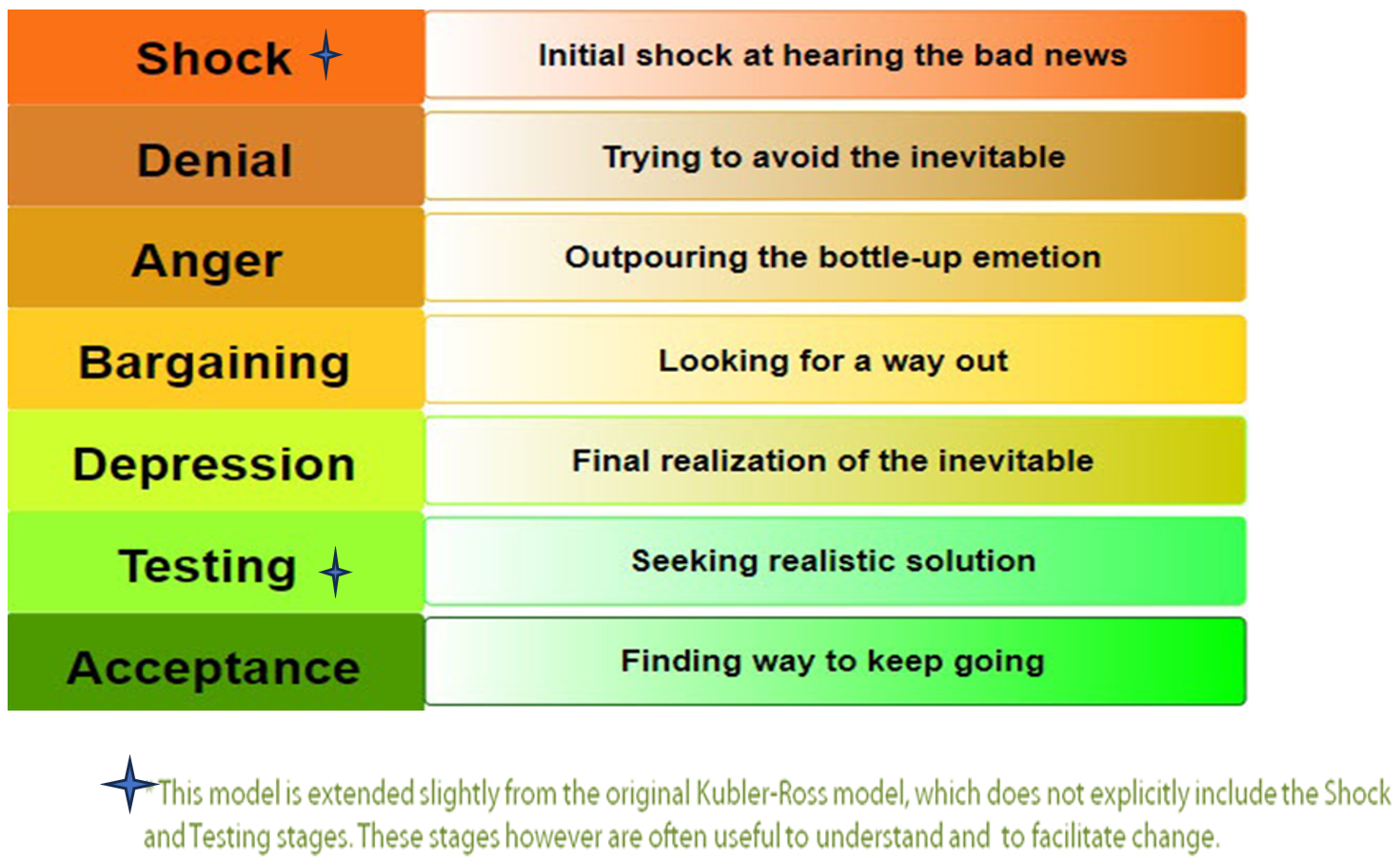
These stages are not linear or universal, but they offer language for what many experience internally. Scripture itself reflects similar emotional depth—lament psalms, for example, move from anguish to trust (Psalm 13).
The Many Manifestations of Grief
Grief touches the whole person. As outlined by PositivePsychology.com, its manifestations can include:
• Spiritual: struggles with faith, anger toward God, or renewed seeking of meaning
• Emotional: sadness, anxiety, guilt, numbness, or even anger
• Physical: fatigue, sleep disruption, bodily pain, or appetite changes
• Behavioral: withdrawal, difficulty concentrating, or changes in daily habits
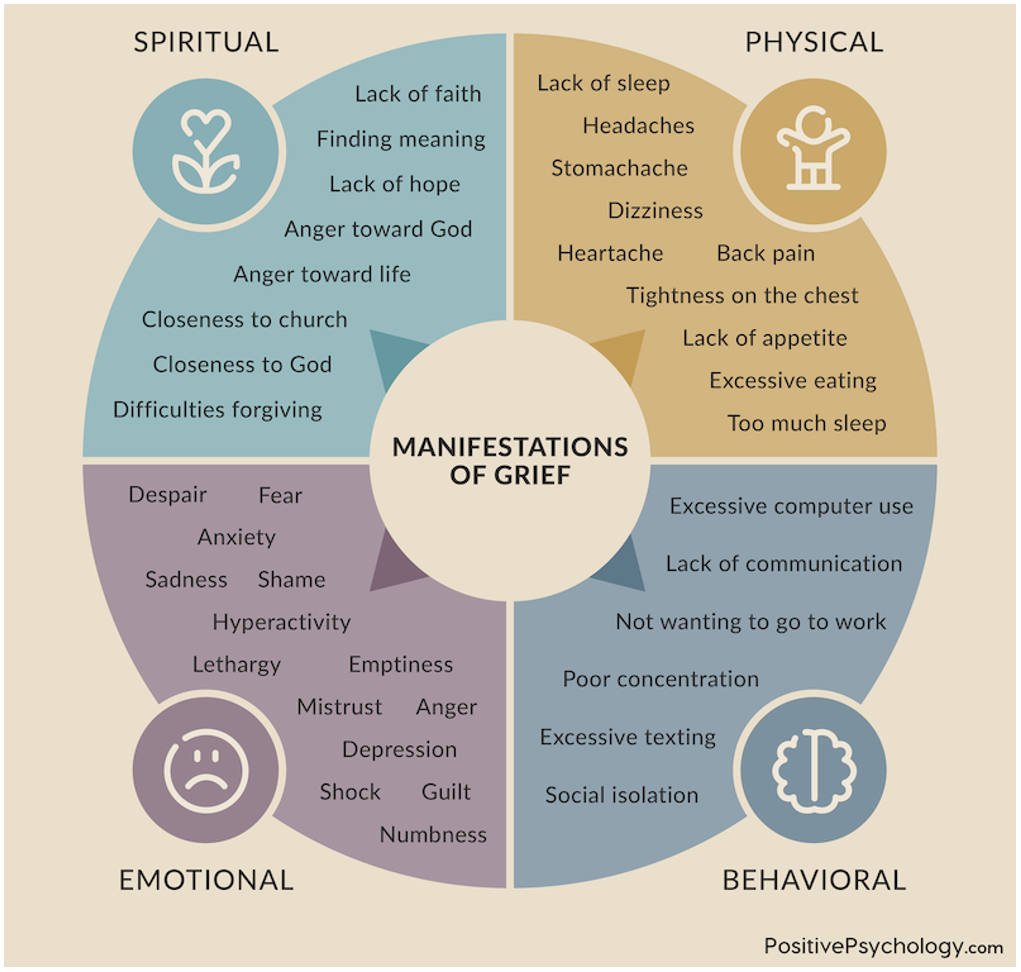
These experiences remind us that grief is not merely emotional—it is holistic. The Church’s care must therefore be holistic as well: Word, Sacrament, community, and compassionate presence.
Easter: The Defining Answer to Grief
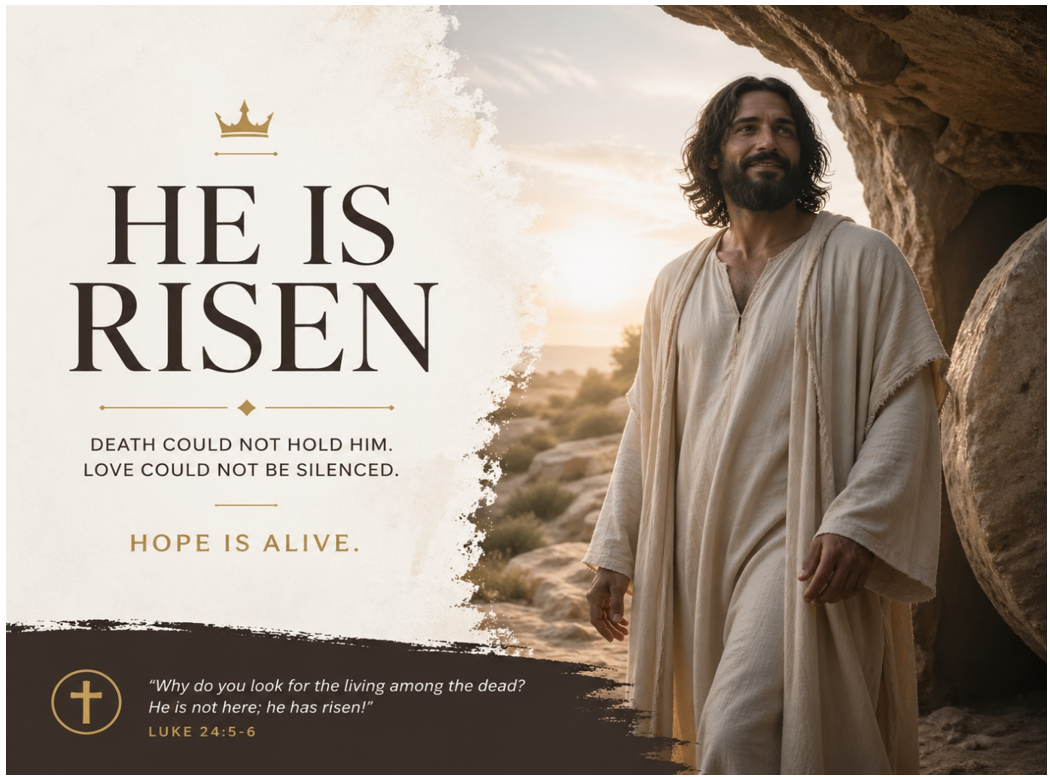
Into this complex reality, Easter speaks a decisive and unshakable truth: death does not have the final word.
St. Paul writes, “If Christ has not been raised, your faith is futile… But in fact Christ has been raised from the dead” (1 Corinthians 15:17, 20). The resurrection of Jesus is not symbolic comfort—it is a historical and cosmic victory over sin, death, and Satan.
Because Christ died for us and was raised for our justification (Romans 4:25), those who belong to Him share in that victory. This means:
• Our grief is real, but not hopeless (1 Thessalonians 4:13).
• Death is an enemy, but a defeated one (1 Corinthians 15:54–57).
• Separation is temporary, not eternal.
The Comfort of the Resurrection Promise
Easter assures believers that they will see their loved ones again—not as vague memory, but in bodily resurrection. Jesus promises: “Because I live, you also will live” (John 14:19). This hope rests not in human optimism but in the saving work of the Triune God—Father, Son, and Holy Spirit.
Luther captured this beautifully when he wrote that for Christians, death is “only a sleep.” Though the pain of separation remains, it is framed by certainty: Christ will call His people forth from the grave.
Living Between Grief and Hope
So how do Christians live during Easter while still grieving?
• Bring grief honestly before God (Psalm 62:8).
• Remain in Word and Sacrament, where Christ meets His people with forgiveness and life.
• Lean on the communion of saints, the Church that bears one another’s burdens (Galatians 6:2).
• Hold fast to the resurrection promise, even when emotions lag.
• Know that in challenging times, Christ, the good Shepherd pursues you: Jesus laid down His life for you – His Sheep (John 10:11– the atonement for your sin – and He was raised for your salvation! His goodness and mercy will follow/pursue you all the days of your life – even as you grieve and struggle in this life (Psalm 23).

Grief may linger, but it does not define the Christian’s future. Easter does.
Individual grief support resources and grief support groups are available through ministries such Stephen Ministries (www.stephenminitries.org) and GriefShare (www.griefshare.org), not-for-profit Christian educational organizations that offer help, hope, and healing.
Conclusion
In this season of resurrection joy, the Church does not demand that sorrow disappear. Instead, she proclaims something stronger: Christ entered into death on the cross and overcame it as our Risen Savior. Therefore, those who grieve do so with hope—a hope grounded in the empty tomb and the promise of the final resurrection, where all who have died in the faith, are justified by God’s grace through faith in Christ alone for the forgiveness of their sins. And where there is forgiveness of sins there is a new life in Christ and eternal salvation whereby their souls will be united with glorified, imperishable, and resurrected bodies (1 Corinthians 15:42), as God comes to be with His people on a new earth and there will be no more death, sorrow or crying (Revelation 21:1-4).
Christ is risen—and because He lives, so shall we, and so shall all who have died in Him.
________________________________________
Endnotes
1. Matthew C. Harrison, “Grieving with Hope,” The Lutheran Witness, 2017.
2. Elisabeth Kübler-Ross, On Death and Dying (New York: Macmillan, 1969); adapted “Modified Kübler-Ross Model of Grief.”
3. “Manifestations of Grief,” PositivePsychology.com, accessed for summary categories (spiritual, emotional, physical, behavioral).
4. The Holy Bible, English Standard Version (ESV): John 11:25–35; Romans 4:25; 1 Corinthians 15; 1 Thessalonians 4:13–18; John 14:19; Psalm 13; Psalm 62:8.
5. Martin Luther, various pastoral writings and letters on death and consolation (16th century).