Grieving with Hope in the Light of Easter

Rev. Bryce RoscheSenior Pastor
May 7, 2026

5 Minute Read

“I am the resurrection and the life. Whoever believes in me, though he die, yet shall he live.” John 11:25 (ESV)

The Easter season arrives each year with triumphant proclamation: Alleluia Christ is risen! He is risen indeed Alleluia! Yet for many Christians, this joy is mingled with quiet sorrow. Empty chairs at family tables, memories that resurface in springtime light, and the lingering ache of loss can make Easter feel bittersweet. The Church does not ignore this tension. Instead, she speaks a deeper word—one that holds grief honestly while anchoring hope firmly in the resurrection of Jesus Christ.

The Reality of Grief in the Christian Life

Grief is not a sign of weak faith; it is a human response to love and loss in a fallen world. Even our Lord Jesus wept at the tomb of Lazarus (John 11:35). As Martin Luther himself experienced profound sorrow through the deaths of loved ones, he wrote candidly about the pain of loss while clinging to Christ’s promises. In “Grieving with Hope,” Rev. Dr. Matthew C. Harrison, synodical president of the Lutheran Church Missouri Synod, reflects on Luther’s struggles, reminding believers that grief and faith are not opposites. Rather, faith gives grief its direction—toward Christ and His promises.[1]

Understanding the Movement of Grief

It can be helpful to consider the Modified Kübler-Ross Model of Grief [2], which describes common experiences people may encounter as they go through a grieving process:
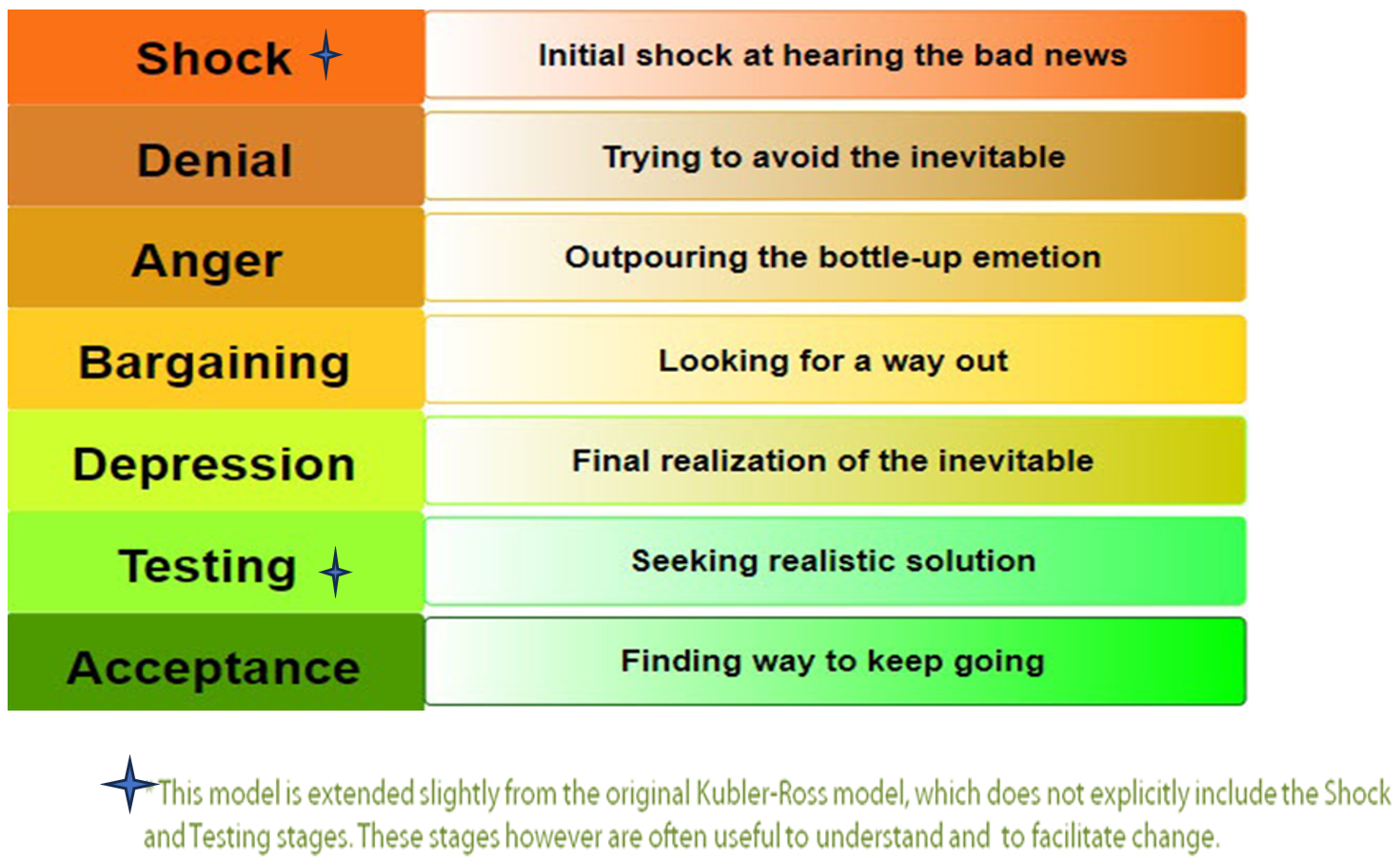


These stages are not linear or universal, but they offer language for what many experience internally. Scripture itself reflects similar emotional depth—lament psalms, for example, move from anguish to trust (Psalm 13).

The Many Manifestations of Grief

Grief touches the whole person. As outlined by PositivePsychology.com, its manifestations can include:

• Spiritual: struggles with faith, anger toward God, or renewed seeking of meaning

• Emotional: sadness, anxiety, guilt, numbness, or even anger

• Physical: fatigue, sleep disruption, bodily pain, or appetite changes

• Behavioral: withdrawal, difficulty concentrating, or changes in daily habits
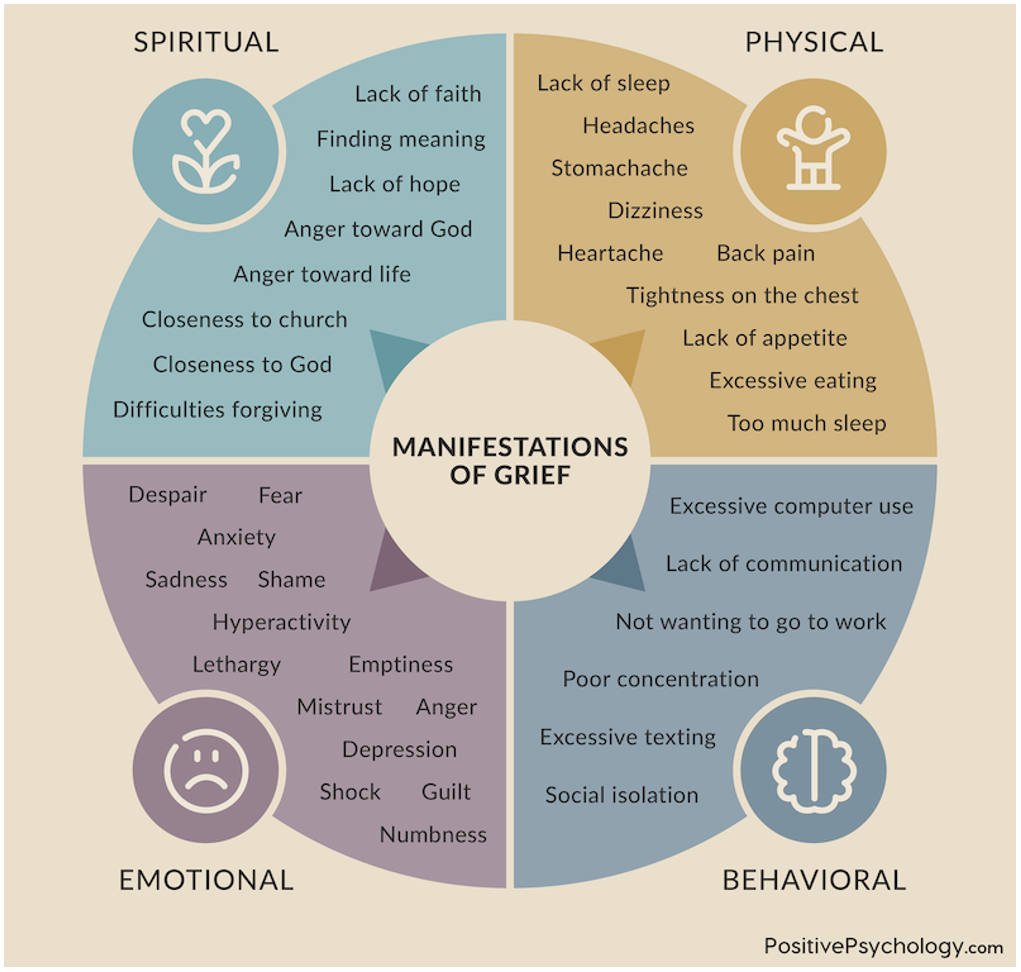

These experiences remind us that grief is not merely emotional—it is holistic. The Church’s care must therefore be holistic as well: Word, Sacrament, community, and compassionate presence.

Easter: The Defining Answer to Grief
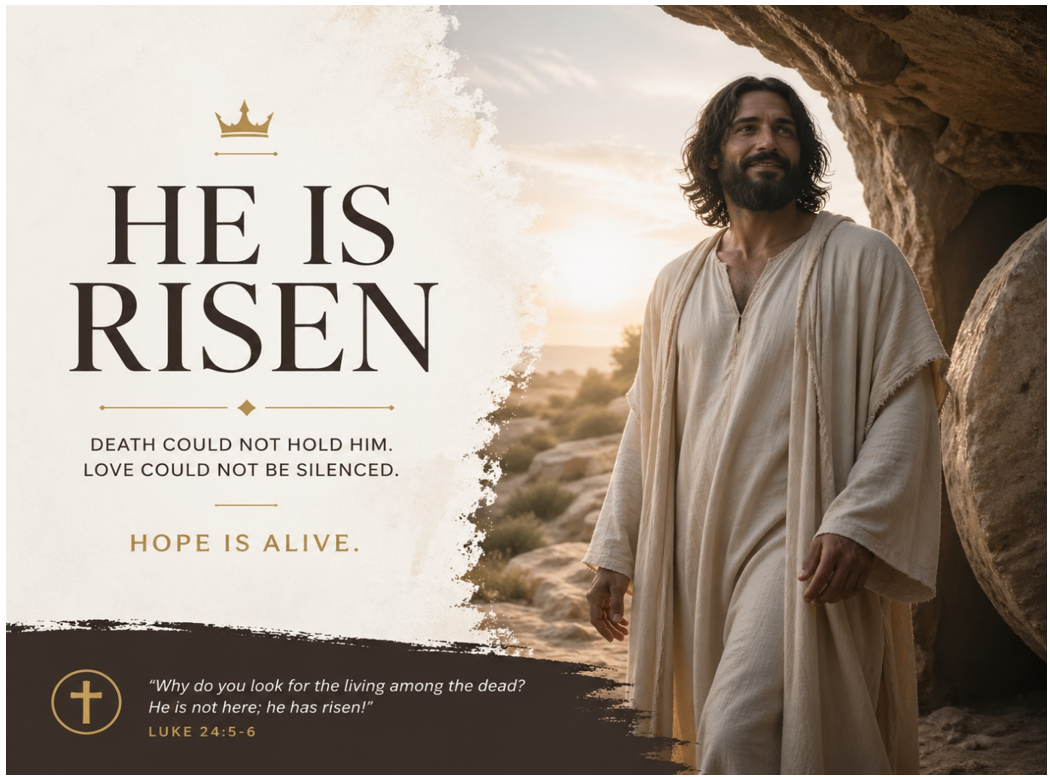

Into this complex reality, Easter speaks a decisive and unshakable truth: death does not have the final word.

St. Paul writes, “If Christ has not been raised, your faith is futile… But in fact Christ has been raised from the dead” (1 Corinthians 15:17, 20). The resurrection of Jesus is not symbolic comfort—it is a historical and cosmic victory over sin, death, and Satan.

Because Christ died for us and was raised for our justification (Romans 4:25), those who belong to Him share in that victory. This means:

• Our grief is real, but not hopeless (1 Thessalonians 4:13).

• Death is an enemy, but a defeated one (1 Corinthians 15:54–57).

• Separation is temporary, not eternal.

The Comfort of the Resurrection Promise

Easter assures believers that they will see their loved ones again—not as vague memory, but in bodily resurrection. Jesus promises: “Because I live, you also will live” (John 14:19). This hope rests not in human optimism but in the saving work of the Triune God—Father, Son, and Holy Spirit.

Luther captured this beautifully when he wrote that for Christians, death is “only a sleep.” Though the pain of separation remains, it is framed by certainty: Christ will call His people forth from the grave.

Living Between Grief and Hope

So how do Christians live during Easter while still grieving?

• Bring grief honestly before God (Psalm 62:8).

• Remain in Word and Sacrament, where Christ meets His people with forgiveness and life.

• Lean on the communion of saints, the Church that bears one another’s burdens (Galatians 6:2).

• Hold fast to the resurrection promise, even when emotions lag.

• Know that in challenging times, Christ, the good Shepherd pursues you: Jesus laid down His life for you – His Sheep (John 10:11– the atonement for your sin – and He was raised for your salvation! His goodness and mercy will follow/pursue you all the days of your life – even as you grieve and struggle in this life (Psalm 23).
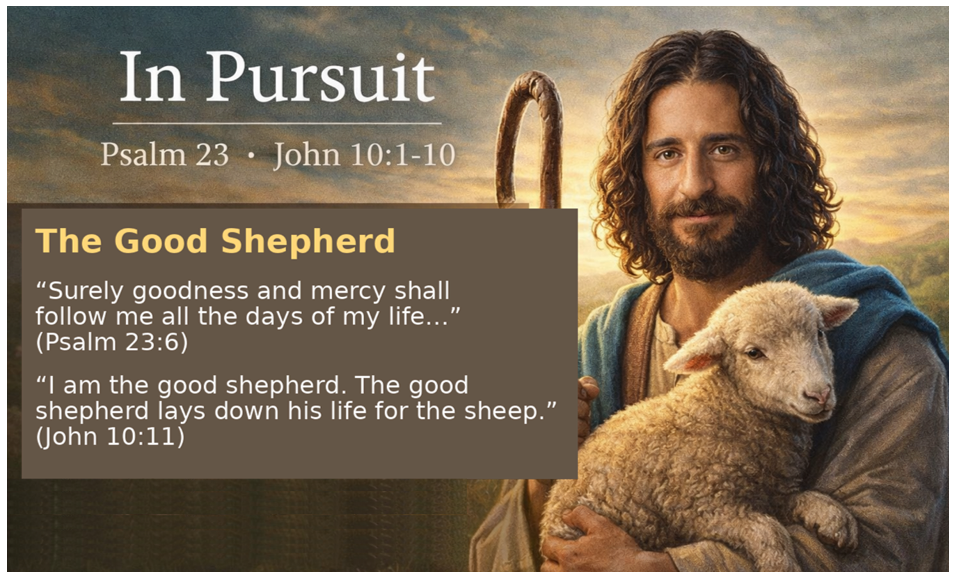

Grief may linger, but it does not define the Christian’s future. Easter does.

Individual grief support resources and grief support groups are available through ministries such Stephen Ministries (www.stephenminitries.org) and GriefShare (www.griefshare.org), not-for-profit Christian educational organizations that offer help, hope, and healing.

Conclusion

In this season of resurrection joy, the Church does not demand that sorrow disappear. Instead, she proclaims something stronger: Christ entered into death on the cross and overcame it as our Risen Savior. Therefore, those who grieve do so with hope—a hope grounded in the empty tomb and the promise of the final resurrection, where all who have died in the faith, are justified by God’s grace through faith in Christ alone for the forgiveness of their sins. And where there is forgiveness of sins there is a new life in Christ and eternal salvation whereby their souls will be united with glorified, imperishable, and resurrected bodies (1 Corinthians 15:42), as God comes to be with His people on a new earth and there will be no more death, sorrow or crying (Revelation 21:1-4).

Christ is risen—and because He lives, so shall we, and so shall all who have died in Him.

________________________________________

Endnotes

1. Matthew C. Harrison, “Grieving with Hope,” The Lutheran Witness, 2017.

2. Elisabeth Kübler-Ross, On Death and Dying (New York: Macmillan, 1969); adapted “Modified Kübler-Ross Model of Grief.”

3. “Manifestations of Grief,” PositivePsychology.com, accessed for summary categories (spiritual, emotional, physical, behavioral).

4. The Holy Bible, English Standard Version (ESV): John 11:25–35; Romans 4:25; 1 Corinthians 15; 1 Thessalonians 4:13–18; John 14:19; Psalm 13; Psalm 62:8.

5. Martin Luther, various pastoral writings and letters on death and consolation (16th century).


Up Next
From this Collection: From the Pastor
April 4, 202610 Minute Read
The Impact of Easter
As Joshua once led the people of Israel across the Jordan River and into the Promised Land (see Joshua 3–4), so Jesus Christ crossed the river of death by His death and resurrection and leads us to the promised land of heaven, which never ends. God’s people now recognize two realities by faith. On the one hand, we recognize that even though the promised land of eternal life is pledged, we do not yet experience heaven in all its fullness nor are able to fully grasp what the new earth will be like at the second coming of Christ as we still live now amid sin, death, and Satan in our world. On the other hand, still on this side of heaven, we trust and believe that God is so gracious to us in Jesus Christ, our resurrected and ascended Lord, that we receive a taste of heaven every time Jesus Christ is preached and every time His divine meal of Holy Communion is served. Easter is the feast of all feasts, because Jesus Christ has risen from the dead to give eternal life to all who believe in Him. That is also why we worship every Sunday; it is a little Easter. “In joyful remembrance of His victory the faithful observe a weekly commemoration which has not displaced but only emphasized the annual observance. (Sunday) is a day of greatest and holiest joy.”[i] Since all of life, hope, and peace is secured by the Lord Jesus, He continues to pass on to us the forgiveness of all our sins, the promise that our body will rise from the grave someday, and the assurance that all who believe in Him will inherit an eternal promised land of a new heaven and new earth. For the Early Church Fathers, this idea of a family reunion, or pilgrimage from Lent toward Easter, was always in mind. Just as Israel of old pilgrimaged for Passover, so does the Church today, from Lent to Easter. The Promised Land was always the hope and goal for the people of Israel, as is eternity for all in the Church today. However, the eternal promised land is not temporal but timeless. The resurrection of Christ and His ascension changed everything in all creation and the entire universe. The Apostle Paul’s message of thanksgiving and hope to his Ephesian congregation is what I echo back to each of each of you as members of St. Matthew Lutheran Church – it is the impact of Easter: 16 I do not cease to give thanks for you, remembering you in my prayers, 17 that the God of our Lord Jesus Christ, the Father of glory, may give you the Spirit of wisdom and of revelation in the knowledge of him, 18 having the eyes of your hearts enlightened, that you may know what is the hope to which he has called you, what are the riches of his glorious inheritance in the saints, 19 and what is the immeasurable greatness of his power toward us who believe, according to the working of his great might 20 that he worked in Christ when he raised him from the dead and seated him at his right hand in the heavenly places, 21 far above all rule and authority and power and dominion, and above every name that is named, not only in this age but also in the one to come. 22 And he put all things under his feet and gave him as head over all things to the church, 23 which is his body, the fullness of him who fills all in all (Ephesians 1:16-23). Christ’s resurrection from the dead “shattered the normal boundaries of time.”[ii] So in the Divine Service when the Sacrament of Christ’s body and blood are served, the entire Church Triumphant and all angels also join the Church Militant in a fantastic feast, a foretaste of the eternal banquet of heaven. Because He is now risen from the dead and lives and reigns to all eternity, all who believe in Him will overcome sin and death and will rise again to new life. Therefore, with angels and archangels and with all the company of heaven we laud and magnify Your glorious name, ever more praising You and saying:[iii] In the Old Testament, God set aside Saturday as a day of rest for his people to worship and ponder the power and goodness of God in His work of creation and the graciousness of God’s work of redemption.[iv] Shabbat (Sabbath), the Jewish day of rest, is a weekly 25-hour period from Friday sunset to Saturday nightfall, commemorating His third commandment, “Remember the Sabbath by keeping it holy” (Exodus 20:8-11; Deuteronomy 5:1,15). "Shabbat Shalom" is a Hebrew phrase translating to "Sabbath of Peace" or "peaceful Sabbath," used as a greeting from Friday afternoon through Saturday evening to wish others a restful, harmonious, and complete rest on the Jewish day of rest. It signifies spiritual wholeness and a peaceful, tranquil day. The Early Church of the New Testament shifted the celebration of the Sabbath from Saturday to Sunday to worship on the day that Jesus rose from the dead (Acts 20:7; John20:19-31). Martin Luther in his small catechism says the following about the Third Commandment’s meaning to us: Although God no longer requires us to observe the Sabbath day (Saturday) and other particular holy days of the Old Testament, this commandment continues to apply to our Christian life and worship (Colossians 2:16-17). We should fear and love God so that we do not despise preaching and His Word but hold it sacred and gladly hear and learn it. The central thought is that God invites us to rest, reflect on His Word, and receive His forgiveness in order to strengthen our faith in Him.[v] The Early Church also emphasized eternal feasting in the eternal promised land of heaven for those who were having their first Communion. So immediately prior to receiving the body and blood of Christ, the new catechumen received a cup mixed with water (symbolizing Baptism’s lasting power) and milk and honey (the food of the Promised Land) to show them that they were entering upon an eternal feast of the promised land by receiving the body and blood of Christ.[vi] The Resurrection of Jesus Christ has received false theoretical interpretations over time (see Figure 1), beginning with the soldiers at the Tomb, who religious leaders instructed to spread the rumor that Jesus’ body was stolen by his disciples at night while the guards were asleep (Matthew 28:11-15). We, however, hold true to the four gospel accounts and the one reality of the authentic resurrection of Jesus Christ! Easter is unlike other feasts because it is one of the highest of the Church Year. Jesus Christ conquered sin, death, and hell through His resurrection from the dead! Now we can partake with the eternal Lamb in a feast of rich foods. Just as Israel longed for the abundant milk and honey of the Promised Land in Canaan, so the Church longs for the eternal feast in our promised land of heaven. We long to be delivered from sin, death, anxiety, and pain. Although we are not there yet, God gives us now a foretaste of that feast in the Lord’s Supper. Christ is the victor, and “to the victor goes the spoils!” Easter breakfast, brunch, and Easter dinners are precious, and they produce enjoyable memories when gathering with family or fellow Christians to celebrate Christ’s resurrection, but God offers each of us something to eat in the Divine Service that is far better than anything else we can gain in the world. Here, you taste the fruit of the promised land itself, milk, and honey. Christ is risen! He is risen indeed! Alleluia! Your risen Lord Jesus gives you His life-giving Word and feeds your hungry soul with His body and blood. Remember the meal of Holy Communion is the feast of the promised land, giving you the foretaste of heaven, and the entirety Scripture can be read in light of the resurrection! Richard Hayes in his text “The Art of Reading Scripture” says the following: When we read Scripture in light of the resurrection, we read it as a story about the power of God who gives life to the dead and calls into existence the things that do not exist. It is not a story about self-help, not a story about human wisdom, not a story about shaping our own identity. It is a story about God - a God who has revealed himself definitively through a mighty act beyond all human capacity, raising Jesus from the dead and transforming the Cosmos. When we read scripture in light of the resurrection, we understand Scripture as testimony to the life-giving power of God. The resurrection of Jesus is not an isolated miracle, but a disclosure of God's purpose finally to subdue death and to embrace us within the life of the resurrection. “As all die in Adam, so all will be made alive in Christ (1 Corinthians 15:22). The God with whom we have to do is the God who wills life and wholeness for us. If we read the biblical story rightly as a story about this God, we will learn to read it in hopeful trust, open to joyous surprises. We will read with hearts open to the divine power disclosed in the resurrection - a power that overthrows all human systems of violence and oppression (see Ephesians 1:17-23). The New Testament resurrection accounts teach us to read the Old Testament as Christian scripture and as figural reading. Figural reading means that the Old Testament’ pointers to the resurrection of Christ are largely indirect and symbolic in character. The Sadducees of Jesus day denied the resurrection, and they were considered literalists when interpreting the Old Testament, but God seems to have delighted in veiled anticipations of the gospel.[viii] To read Scripture in light of the resurrection is to read with emphasis on eschatological (end-times) hope, where we as believers will be raised from the dead with glorious imperishable bodies (1 Corinthians 15:40-45) , united holistically in body and soul – fully human as our God intended us to be as he comes to be with His people on a new earth with new heavens (Revelation 21:1-5). [i] Fred H. Lindemann, The Sermon and the Proper’s, vol. 2, Pre-Lent to Pentecost (Concordia Publishing House: St. Louis, 1958), 127. [ii] Thomas M. Finn, Early Christian Baptism and the Catechumenate, vol. 6, Italy, North Africa, and Egypt (The Liturgical Press: Collegeville, MN, 1992), 10 [iii] LSB, p. 208 [iv] Luther, Luther’s Small Catechism with Explanation (St. Louis, MO: Concordia Publishing House, 2017), pp.77,74. [v] IBID, p.74 [vi] Thomas M. Finn, Early Christian Baptism and the Catechumenate, vol. 5, West and East Syria (The Liturgical Press: Collegeville, MN, 1992), 17. [vii] Nelson’s Complete Book of the Bible Maps and Charts 1993 by Thomas Nelson, Inc. [vii] Davis, Ellen F. & Hayes, Richard B.; The Art of Reading Scripture, William B. Eerdmans Publishing Company, Grand Rapids, MI / Cambridge, U.K., pp.
Currently Reading
May 7, 20265 Minute Read
Grieving with Hope in the Light of Easter
“I am the resurrection and the life. Whoever believes in me, though he die, yet shall he live.” John 11:25 (ESV) The Easter season arrives each year with triumphant proclamation: Alleluia Christ is risen! He is risen indeed Alleluia! Yet for many Christians, this joy is mingled with quiet sorrow. Empty chairs at family tables, memories that resurface in springtime light, and the lingering ache of loss can make Easter feel bittersweet. The Church does not ignore this tension. Instead, she speaks a deeper word—one that holds grief honestly while anchoring hope firmly in the resurrection of Jesus Christ. The Reality of Grief in the Christian Life Grief is not a sign of weak faith; it is a human response to love and loss in a fallen world. Even our Lord Jesus wept at the tomb of Lazarus (John 11:35). As Martin Luther himself experienced profound sorrow through the deaths of loved ones, he wrote candidly about the pain of loss while clinging to Christ’s promises. In “Grieving with Hope,” Rev. Dr. Matthew C. Harrison, synodical president of the Lutheran Church Missouri Synod, reflects on Luther’s struggles, reminding believers that grief and faith are not opposites. Rather, faith gives grief its direction—toward Christ and His promises.[1] Understanding the Movement of Grief It can be helpful to consider the Modified Kübler-Ross Model of Grief [2], which describes common experiences people may encounter as they go through a grieving process: These stages are not linear or universal, but they offer language for what many experience internally. Scripture itself reflects similar emotional depth—lament psalms, for example, move from anguish to trust (Psalm 13). The Many Manifestations of Grief Grief touches the whole person. As outlined by PositivePsychology.com, its manifestations can include: • Spiritual: struggles with faith, anger toward God, or renewed seeking of meaning • Emotional: sadness, anxiety, guilt, numbness, or even anger • Physical: fatigue, sleep disruption, bodily pain, or appetite changes • Behavioral: withdrawal, difficulty concentrating, or changes in daily habits These experiences remind us that grief is not merely emotional—it is holistic. The Church’s care must therefore be holistic as well: Word, Sacrament, community, and compassionate presence. Easter: The Defining Answer to Grief Into this complex reality, Easter speaks a decisive and unshakable truth: death does not have the final word. St. Paul writes, “If Christ has not been raised, your faith is futile… But in fact Christ has been raised from the dead” (1 Corinthians 15:17, 20). The resurrection of Jesus is not symbolic comfort—it is a historical and cosmic victory over sin, death, and Satan. Because Christ died for us and was raised for our justification (Romans 4:25), those who belong to Him share in that victory. This means: • Our grief is real, but not hopeless (1 Thessalonians 4:13). • Death is an enemy, but a defeated one (1 Corinthians 15:54–57). • Separation is temporary, not eternal. The Comfort of the Resurrection Promise Easter assures believers that they will see their loved ones again—not as vague memory, but in bodily resurrection. Jesus promises: “Because I live, you also will live” (John 14:19). This hope rests not in human optimism but in the saving work of the Triune God—Father, Son, and Holy Spirit. Luther captured this beautifully when he wrote that for Christians, death is “only a sleep.” Though the pain of separation remains, it is framed by certainty: Christ will call His people forth from the grave. Living Between Grief and Hope So how do Christians live during Easter while still grieving? • Bring grief honestly before God (Psalm 62:8). • Remain in Word and Sacrament, where Christ meets His people with forgiveness and life. • Lean on the communion of saints, the Church that bears one another’s burdens (Galatians 6:2). • Hold fast to the resurrection promise, even when emotions lag. • Know that in challenging times, Christ, the good Shepherd pursues you: Jesus laid down His life for you – His Sheep (John 10:11– the atonement for your sin – and He was raised for your salvation! His goodness and mercy will follow/pursue you all the days of your life – even as you grieve and struggle in this life (Psalm 23). Grief may linger, but it does not define the Christian’s future. Easter does. Individual grief support resources and grief support groups are available through ministries such Stephen Ministries (www.stephenminitries.org) and GriefShare (www.griefshare.org), not-for-profit Christian educational organizations that offer help, hope, and healing. Conclusion In this season of resurrection joy, the Church does not demand that sorrow disappear. Instead, she proclaims something stronger: Christ entered into death on the cross and overcame it as our Risen Savior. Therefore, those who grieve do so with hope—a hope grounded in the empty tomb and the promise of the final resurrection, where all who have died in the faith, are justified by God’s grace through faith in Christ alone for the forgiveness of their sins. And where there is forgiveness of sins there is a new life in Christ and eternal salvation whereby their souls will be united with glorified, imperishable, and resurrected bodies (1 Corinthians 15:42), as God comes to be with His people on a new earth and there will be no more death, sorrow or crying (Revelation 21:1-4). Christ is risen—and because He lives, so shall we, and so shall all who have died in Him. ________________________________________ Endnotes 1. Matthew C. Harrison, “Grieving with Hope,” The Lutheran Witness, 2017. 2. Elisabeth Kübler-Ross, On Death and Dying (New York: Macmillan, 1969); adapted “Modified Kübler-Ross Model of Grief.” 3. “Manifestations of Grief,” PositivePsychology.com, accessed for summary categories (spiritual, emotional, physical, behavioral). 4. The Holy Bible, English Standard Version (ESV): John 11:25–35; Romans 4:25; 1 Corinthians 15; 1 Thessalonians 4:13–18; John 14:19; Psalm 13; Psalm 62:8. 5. Martin Luther, various pastoral writings and letters on death and consolation (16th century).