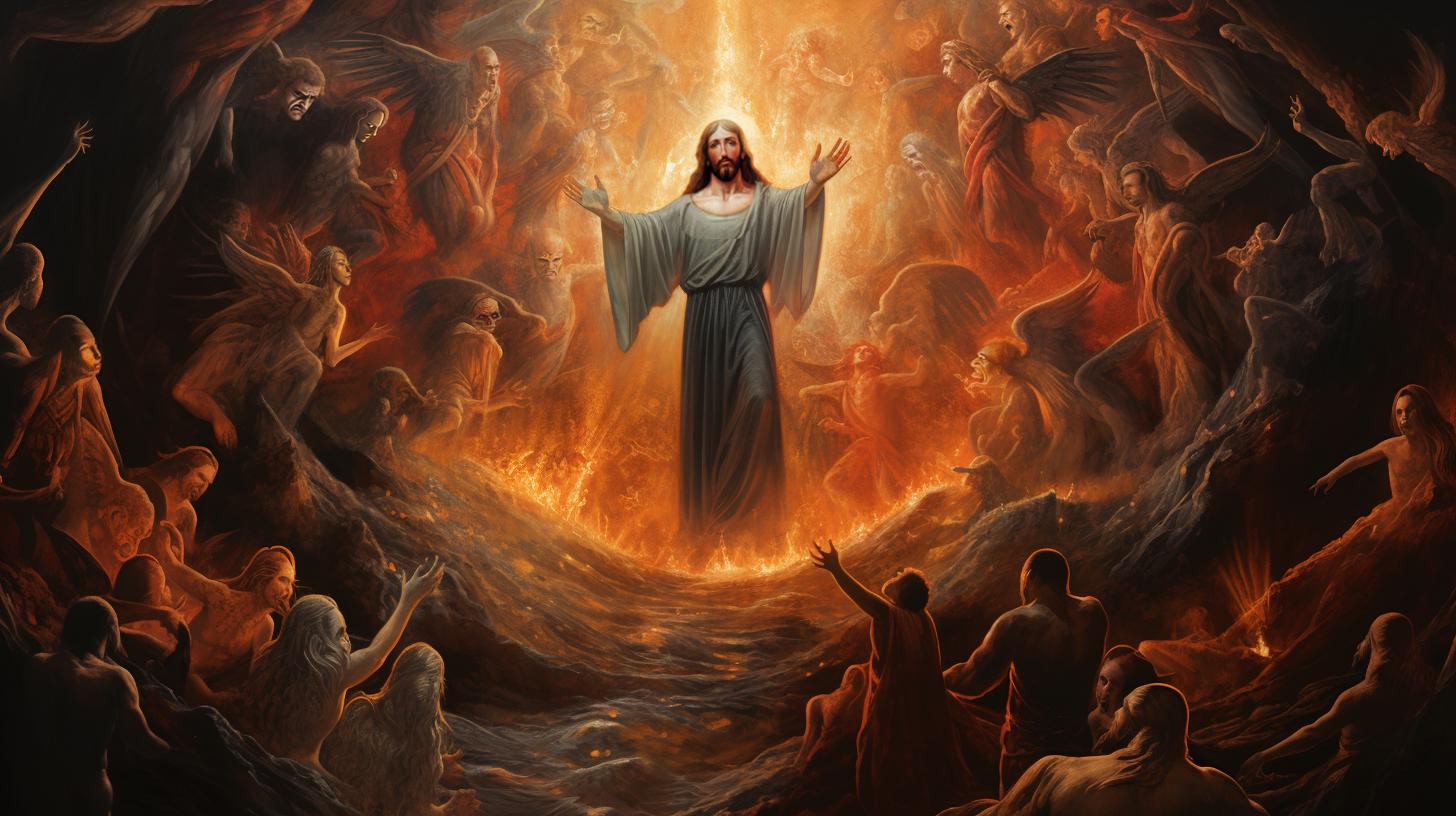
Every Sunday, Christians around the world recite the Apostles' Creed, declaring their belief that Jesus "descended into hell." Yet this phrase often leaves believers puzzled. What exactly happened when Christ descended into hell, and why does it matter for our faith today?
The Mystery in Scripture
The concept of Christ's descent into hell appears most clearly in 1 Peter 3:18-20: "For Christ also suffered once for sins, the righteous for the unrighteous, that he might bring us to God, being put to death in the flesh but made alive in the spirit, in which he went and proclaimed to the spirits in prison, because they formerly did not obey, when God's patience waited in the days of Noah, while the ark was being prepared" - 1 Peter 3:18-20 (ESV).
This passage has puzzled theologians for centuries. Even Martin Luther, the great reformer who translated the entire Bible, admitted his struggle with this text. In his commentary, Luther wrote: "This is a strange text, certainly a more obscure passage than any other passage in the New Testament. I still did not know for sure what the apostle even means."
How Has the Church Understood This Throughout History?
Early Church Interpretations
Throughout church history, Christians have offered various interpretations of Christ's descent into hell:
The Harrowing of Hell (12th Century): Early artwork depicted Christ descending to rescue Old Testament believers who were supposedly trapped under hell's gates until his arrival.
Descent into Limbo (Medieval Period): Some believed Christ descended to free souls stuck in an intermediate state between heaven and hell.
Preaching to Spirits: Another view suggested Christ offered a second chance of salvation to those who had died.
Luther's Simple Approach
By 1533, Luther had developed a clearer understanding. Rather than getting lost in complex theological debates, he advocated for a simple interpretation. In his sermon at Torgau Castle, Luther explained that Christ descended into hell not to rescue souls or offer second chances, but to proclaim his victory over Satan and all evil forces.
Luther emphasized: "I want to stick with the simplest understanding, what the words mean, how one would describe it to children and to the simple-minded... the surest thing of all is whoever wishes to keep from veering off the straight path, let him stick to the words and imagine them for himself in the simplest way as he can."
What Does Christ's Victory Mean?
A Declaration of Conquest
When Christ descended into hell, he wasn't going there as a prisoner or victim. He went as the conquering King to declare his absolute victory over Satan, death, and all evil powers. This wasn't about rescuing souls already condemned, but about proclaiming that the battle was won.
The Connection to Noah's Flood
The passage in 1 Peter draws a parallel between Noah's time and Christ's victory. Just as God pronounced judgment on the corrupt world through the flood while saving Noah's faithful family, Christ's descent into hell was a pronouncement of final judgment on the rebellious spirits who had opposed God.
The eight people saved in Noah's ark represent God's faithful remnant, while the flood represents both judgment and cleansing - much like baptism washes away our sins through Christ's victory.
What Scripture Says About Christ's Victory
Several passages support this understanding of Christ's triumphant descent:
"He disarmed the rulers and authorities and put them to open shame, by triumphing over them in him" - Colossians 2:15 (ESV).
"I died, and behold I am alive forevermore, and I have the keys of Death and Hades" - Revelation 1:18 (ESV).
"Therefore God has highly exalted him and bestowed on him the name that is above every name, so that at the name of Jesus every knee should bow, in heaven and on earth and under the earth" - Philippians 2:9-10 (ESV).
Why This Matters for Christians Today
Complete Security in ChristChrist's descent into hell assures us that his victory is total and complete. There is no power in heaven, on earth, or under the earth that can separate us from God's love. As Paul writes: "For I am sure that neither death nor life, nor angels nor rulers, nor things present nor things to come, nor powers, nor height nor depth, nor anything else in all creation, will be able to separate us from the love of God in Christ Jesus our Lord" - Romans 8:38-39 (ESV).
Confidence in Sharing Our Faith
Because Christ has conquered every opposing force, we can share our faith with confidence. Peter encourages us: "But in your hearts honor Christ the Lord as holy, always being prepared to make a defense to anyone who asks you for a reason for the hope that is in you; yet do it with gentleness and respect" - 1 Peter 3:15 (ESV)
Notice the emphasis on gentleness and respect. We don't need to be aggressive or harsh when sharing the gospel because the victory is already won. We can approach others with the same grace Christ showed us.
Life Application
Christ's descent into hell reminds us that no situation in our lives is beyond his power and authority. When we face overwhelming circumstances, remember that our Savior has already conquered the ultimate enemies - sin, death, and Satan himself.
This week, let this truth transform how you approach challenges and how you interact with others. Since Christ has won the ultimate victory, you can face difficulties with confidence and share your faith with gentleness rather than defensiveness.
Ask yourself these questions:
- Am I living with the confidence that comes from knowing Christ has already won the ultimate victory?
- When I share my faith with others, do I do so with gentleness and respect, trusting in Christ's power rather than my own arguments?
- How can I better reflect the security I have in Christ's complete triumph over all opposing forces?
Christ descended, proclaimed victory, and prevailed. Because of this, our hope in him as our Redeemer is secure forever. No power can snatch us from his hands, and no force can separate us from his love.